The UK's authority on safe mould removal and water damage.
Independent, evidence-based guidance to help you find the right information, professional, or organisational support to protect your health and property.

Awaab's Law set the clock running.
Since October 2025, social landlords have had fixed statutory deadlines for damp and mould hazards — with the scope widening through 2026 as Phase 2 brings in a wider set of HHSRS hazards. Our training helps providers meet the timeline and evidence that they have.
Maximum time to make an emergency hazard safe.
Maximum time to investigate a significant damp or mould hazard.
To give residents a written summary of what was found.
A general summary for orientation, not legal advice — providers should work from the current government guidance for their exact statutory obligations.
Explore organisational supportEstablishing the extent of the damage
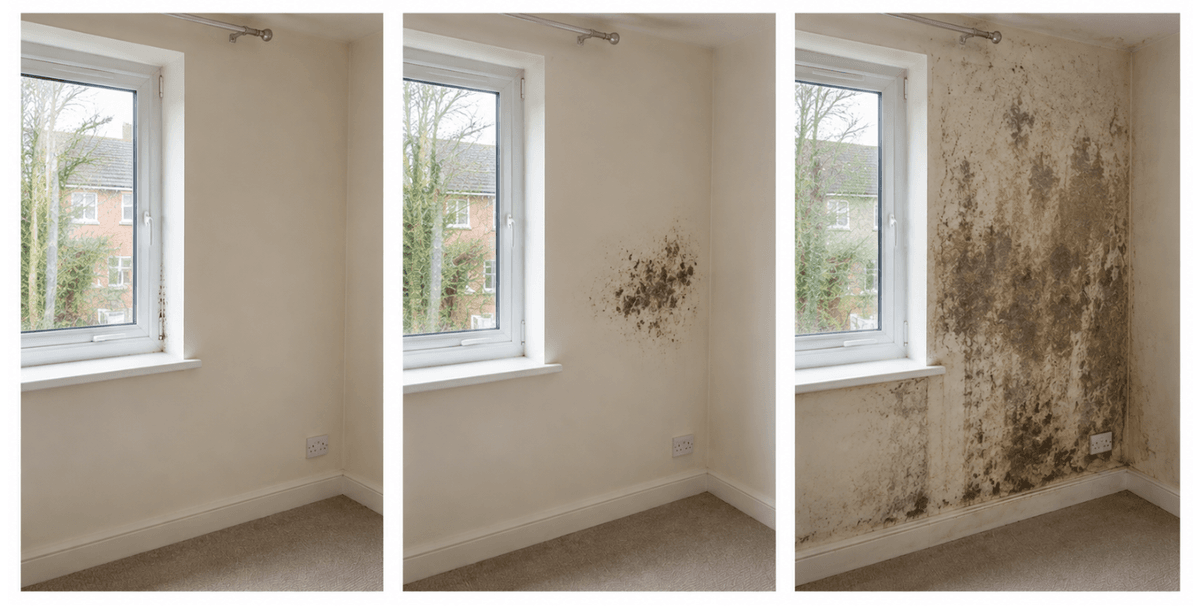
We classify water damage and mould affected buildings using a scale. This is based on scientific research from the German Environment Agency.
Marker shows a typical single-room condensation case before ventilation works — moderate extent, worth investigating but not necessarily hidden or structural.
How we define Small / Moderate / Extensive
| Extent of damage | Category 1Normal condition or minor mould infestation | Category 2Low to medium mould infestation | Category 3Extensive mould infestation |
|---|---|---|---|
| Growth on the surface and in the medium | Minor surface damage< 20cm² | Superficial growth< 0.5m²,deeper layers are only affected locally | Large surface growth> 0.5m²,deeper layers can also be affected |
| Resulting microbial biomass | No or very little microbial biomass | Medium microbial biomass | Large microbial biomass |
Shared experiences.
People who've worked with UKCMS or used its guidance, in their own words.
“UKCMS has supported our organisation in upskilling to deliver the gold standard in mould remediation.”

“The team at UKCMS are by far the most knowledgeable on safe mould removal - it’s such a big knowledge gap.”

“My children were so sick I didn’t know where to turn. UKCMS guided us every step of the way to safety.”

“We are a father son remediation team and had always used chemicals. UKCMS guided us to the safe approach.”

“I work for a council and was trained by the team on the safe way to removal mould. A complete game-changer.”

“As a bathroom fitter I come across mould often. Now I know how to safely remove it thanks to UKCMS.”

Still not sure what you need?
The Navigator takes about three minutes and points you to the right next step.